HEYSHOTT
Chapter 5 cont.
Pages 31 - 34
pages 31 to 34 are extracts from the of Hungry Forties
click here to open
Pages 31 - 34
balance of Page 34
End of extracts.
MENS CLOTHES.
Older men in Heyshott around the late 1880's used to wear a type of smock, or as they were called in those days 'Cow gowns'; another type of dress was a 'round gown' which was pleated round the neck and made of heavy brown linen material.
Usually the younger men of the village wore coats with trousers made of either corduroy or a canvas type of material.
Page 34
Page 35
In summer a loose cotton coat called 'Slops' with 'Yorks' tied or strapped round the trousers just below the knee was worn. This was to stop the mice or rats from runnning up the leg during harvest time. The men who could afford it wore leather gaiters shaped to the leg or either laced or buttoned up.
Head dress was usually worn and most common would be a flat cap made of cloth or felt called 'Billycocks'. Another type called 'Chummies' were made of felt with a braid around the crown which had a white 'Horse-shoe' on it.
On their feet the workers usually wore rather heavy boots. School children wore clogs or boots to school.
Women's Clothes.
The older women in the village of the 1880's wore crinolines to the time they died. The younger women wore coloured shawls around the home and sometimes wore a white cap on Sundays and special occasions. When going out they would wear a white cap on a hat trimmed with braid and beads. To go to church on Sunday a bonnet was the thing.
Two sisters, the Misses Dickenson ran a clothing club in one of the Newells cottages where women of the village could buy clothing, including red flannel from which they made petticoats. This was about 1900 or so.
Sawyers of Heyshott
Sawyers were men who sawed tree trunks into planks. In Heyshott this was done by a few men who would be self employed as they would make more money than working for a landlord. The work was not only done in the village but they would go to other places to do this work, walking over the Downs to Singleton and beyond of a morning and back again at night, this would be some six miles each way.
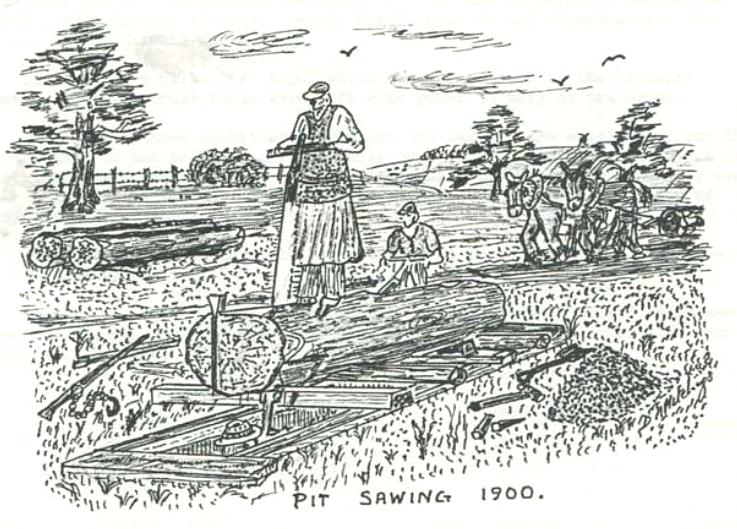
It was a hard day's work. The system used in the 18th. century was to cut down the tree and remove the branches, then it is more than likely to stay out for perhaps another year or longer to dry out. The sawyer would then come along, and if required, dig a hole or pit of a suitable size, select some straight poles and lay them across the long sides of the pit, maybe three or four, strong enough to support the heaviest trunk. The pit would no doubt be drained by some method, but not need any special drainage if dug in the chalk of the Downs. A tree trunk would then be rolled or dragged by a horse to the pit and placed over the pit at right-angles to the logs and wedged in place. To make these adjustments a ring dog and lever would be used and when in the final position a straight spiked dog was driven into the trunk and the other end driven into the log over the pit, this would hold the trunk firm in position ready for sawing.
The sawyers would then take up the two man cross-cut saw and with one man standing in the pit and the other man on top of the trunk start sawing at one end and saw away until reaching the first cross log and would go back again and start again on the second cut at the required thickness of the plank and this may be done several times depending on the size of the trunk, using wedges in the end of the saw cut to keep the cut open, for the saw not to be pinched.
Page 36
The saw handles are detachable to enable the blade to be withdrawn, this allows the trunk to be moved along its length, by using the support logs as rollers. Now the saw cuts are past the first support log sawing can now proceed until the next support leg is reached this procedure continues until the tree trunk has been sawn into planks.
The planks would be taken away and laid out with spacers between them and left to cure for some months or perhaps years, before they would be used for making carts and buildings etc..
The operation has completely changed within the last 50 years since the advent of the caterpillar tractors, power operated circular saws and band saws.
Page 36
This transcription was kindly written by Deidre Millington, of Nottinghamshire
|