This section of the book has been re-edited to include the journey through the area currently covered by this website.
A full version of the book is available in Eformat - from Lewes to Bosham
THE SOUTH DOWNS FROM END TO END - 1920
By
Edric Holmes
Illustrations by
Mary M. Vigers
[1920]
page 3
CHAPTER VIII
MIDHURST TO GOODWOOD AND BOGNOR
We now leave the Rother, turn south by the Chichester road and passing over Cocking causeway reach, in three miles, that little village at the foot of the pass through the Downs to
Singleton, or better still, by taking a rather longer route through West Lavington we may see the church in which Manning preached his last sermon as a member of the Anglican communion. The church and accompanying buildings date from 1850 and were designed by Butterfield; they are a good example of nineteenth-century Gothic and are placed in a fine situation. In the churchyard, which is particularly well arranged, lies Richard Cobden not far from the farmhouse in which he was born. Dunford House is not far away; this was presented to Cobden by the Anti-Corn-Law League, and here the last years of his life were spent.
Cocking once had a cell belonging to the Abbey of Seez in Normandy but of this nothing remains. This beautifully situated little place has a primitive Norman church with a fine canopied tomb and an old painting of Angel and shepherds. We are now at the foot of Charlton Forest covering the slopes of the Downs which stretch eastwards to Duncton Beacon; and along the edge of this escarpment it is proposed to travel. This is one of the loneliest and most beautiful sections of the range.
"A curious phenomenon is observable in this neighbourhood. From the leafy recesses of the layers of beech on the escarpment of the Downs, there rises in unsettled weather a mist which rolls among the trees like the smoke out of a chimney. This exhalation is called 'Foxes-brewings' whatever that may mean, and if it tends westwards towards Cocking, rain follows speedily." [Lower.]
The hamlet of
Heyshott need not tempt us from the hill, though
Graffham, one of the loveliest villages in Downland, might well be visited. Where at last it is necessary to drop toward the Petworth Chichester road a divergence may be made to East Lavington with its associations and memories of Samuel Wilberforce, who is buried here and in whose memory a memorial brass may be seen in the church; note also the Bishop's pastoral staff fixed to the wall near the altar. There are still "oldest inhabitants" of this peaceful place who remember the celebrated Victorian, whose rather unkind sobriquet was really but a tribute to his genial kindliness of disposition. Here he married in 1828 the local heiress, Miss Emily Sergent, and here Mrs. Wilberforce was buried in 1841. It is said that at Oxford, or wherever the Bishop was resident, there hung in his bedroom a picture of Lavington churchyard "that I may ever see my own resting place."
THE SUSSEX DOWNS FROM END TO END
The following summary will suggest to the stranger how his time, if limited, could be so disposed as to take in the whole range with those villages which are essentially Downland settlements and those which lie immediately at the foot of the escarpment. For this purpose the order of the book is reversed and the tourist should start at the western or Hampshire end and finish his walk at
Beachy Head. The enjoyment of this tour will of course be greatly enhanced if half the distance is traversed each day, thus doubling the time.
1st DAY. - Midhurst [Angel Inn] or Cocking Station via Lynch Down, Beacon Hill, to Harting, 9 miles [Ship Inn].
2nd DAY. - Harting to Bow Hill and Kingley Bottom via North and East Marden, 8 miles; on to West Dean, Singleton and Cocking [Inn], 17 miles; or Midhurst, 20 miles.
3rd DAY. - Cocking by Heyshott Down and Duncton Beacon to East Dean, 7 miles [Inn]; on by Burton Down and Bignor Hill [Stane Street] to Bignor, 13 miles [Inn]; on to Amberley, 19 miles [Inn].
4th DAY. - Amberley to Rackham and Kithurst Hills; down to Storrington [White Horse Inn], 5 miles. By the main road to Washington [Inn] and Wiston. Ascend Chanctonbury Ring, 10 miles; on to Cissbury Ring and over Downs at Steyning, 16 miles [White Horse].
5th DAY. - Steyning via Bramber and Upper Beeding to Trueleigh Hill and Devil's Dyke, 6 miles [Inn]; down to Poynings, round Newtimber Hill to Pyecombe and Wolstonbury, thence by hill road to Ditchling Beacon, 12 miles; on by edge of Downs to Mount Harry and down to Lewes, 18 miles [White Hart, Crown, etc.]
6th DAY. - Lewes over Cliffe Hill and Mount Caburn to Glynde and West Firle, 4 miles [Inn]; over Firle Beacon and along edge of Downs to Alfriston, 9 miles [Star Inn]; by Lullington to Windover Hill ["Long Man of Wilmington"] down to Jevington, 12 miles [Inn]; up to Willingdon Hill and thence by eastern edge of Downs all the way to Beachy Head, 17 miles. Eastbourne, 20 miles.
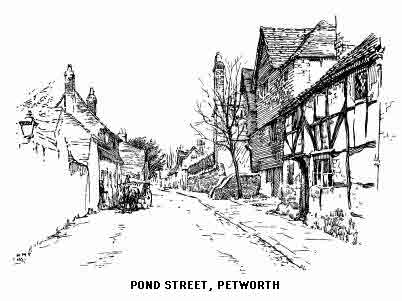
[Pound Street, Petworth]
THE CHICHESTER ROAD VIA GUILDFORD & MIDHURST
This route follows the Portsmouth Road from Westminster through Wandsworth and over Putney Heath to Kingston [12 m.]. Here we bear left past the King's stone and then by way of the river bank through Thames Ditton to Esher [16 m.], then by the famous "Ripley Road" over Fairmile Common and through Street Cobham [19½ m.].
Ripley [23¾ m.].
Guildford [29¾ m.]. A prosperous and good-looking old town in danger of becoming smug and suburban; the steep and picturesque High Street, however, keeps its old time amenities. The ruins of the castle keep may be seen south of the High Street. Abbott's Hospital [1619], the Guildhall with projecting clock [1683]; St. Mary's church, Norman and Early English. Note paintings in north chapel. St. Nicholas' Church has been mostly rebuilt. Our road turns left just beyond the Wey bridge and passes under the ruins of St. Catherine's Chapel on the left. At Shalford [30¾ m.], bear right to Godalming [34¼ m.] in the centre of a lovely country. Here is a large cruciform church, Norman and Early English, with interesting brasses and pulpit.
Milford [35 m.]. A long rise follows to Brookstreet [39¼ m.] and a dangerous drop just beyond. Haslemere [43 m.]. Although the scenery is very beautiful on all sides of this once remote hamlet, the late nineteenth century saw a colonization of the slopes of Hindhead, with the attendant outbreak of red brick, which has almost completely spoilt the neighbourhood. Branch excursions may be made towards the Hampshire border and to Chiddingfold country. We cross the Sussex boundary one mile south of the town and are immediately in the lonely and very lovely Blackdown country. A climb follows to Kingsley Marsh and a steep descent to Fernhurst [46¼ m.].
[Blackdown, the highest point in Sussex [918 feet] can be easily reached from here, the distance is about two miles in each direction with woodland most of the way. The view from the summit is magnificent in every direction. Aldworth, where Tennyson died, is on a spur of the hill slightly east of north.]
Henley [48½ m.]. A picturesque hamlet below the road commanding magnificent views of Blackdown. A steep descent, then a road through lovely woodlands brings us to Midhurst [51 m.].
|