This section of the book has been re-edited to include the journey through the area currently covered by this website.
A full version of the book is available in Eformat - from Lewes to Bosham
THE SOUTH DOWNS FROM END TO END - 1920
By
Edric Holmes
Illustrations by
Mary M. Vigers
[1920]
page 2
THE ROAD TO MIDHURST
The road now goes directly west and in a mile reaches Tillington, which has a Transitional church modernized and practically rebuilt by the Earl of Egremont; here are several interesting tombs and brasses. A divergence two miles further will take us downhill across the Rother to Selham [with a station close to the village]. The Norman and Early English church has a chancel arch with finely carved and ornamented capitals. Proceeding westwards between high banks of red sandstone our road soon approaches Cowdray Park, across which it runs without hedge or fence.
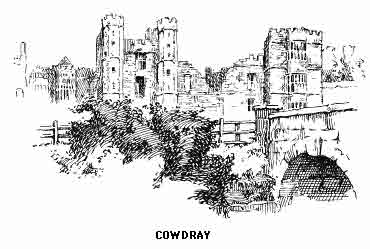
The park is a beautiful pleasaunce for the inhabitants of Midhurst; thickly carpeted with bracken and heather and broken by many picturesque knolls and hollows. The famous burned and ruined mansion lies on the west, close to the town and river. This beautiful old house was destroyed in 1793 through the carelessness of some workmen employed in repairing the woodwork of some of the upper rooms. Within a month of the calamity the last of the Montagues, a young man of 22, was drowned while shooting the falls of the Rhine at Schaffhausen. These tragic happenings were supposed to fulfil a curse of the last monk of Battle pronounced against Sir Anthony Browne when he took possession of the Abbey. "Thy line shall end by fire and water and utterly perish."
The following is a contemporary account of the tragedy: "Lord Montague was engaged to the eldest daughter of Mr. Coutts [the present Countess of Guildford] and, with a view to his marriage on his return to England, the mansion house had been for several months undergoing a complete repair and fitting up. The whole was completed on the day preceding the night on which it was consumed, and the steward had been employed during the afternoon in writing the noble owner an account of its completion. This letter reached his hands. On the following day the steward wrote another letter announcing its destruction: but in his hurry of spirits, he directed it to Lausanne instead of Lucerne, by which accident it was two days longer in its passage to his lordship's place of abode than it otherwise would have been. Had it not been for that fatal delay, in all human probability this noble family would not have had to deplore the double misfortune by which its name and honours have become extinguished; for the letter arrived at his lordship's lodging on the morning of his death, about an hour after he had left them, and, as nearly as can be computed at the very moment in which he was overwhelmed by the torrent of the Rhine."
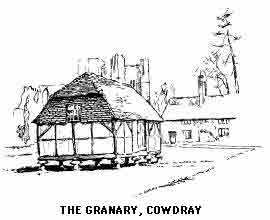
The turreted entrance gateway is less ruinous than the remainder of the buildings and, with the banqueting hall, is as fine a specimen of early sixteenth-century architecture as will be found in England. Notice the vaulted entrance to the Hall. On the north side, looking towards the Guard House is the State Bedchamber, wherein Queen Elizabeth slept in 1591. There are several contemporary accounts of the stately merrymakings which took place during the visit, including the "hunting" scene in which buck deer were guided past Gloriana's bower, from which she made dead shots at them, reminding one of the "bulls-eyes" with which a later Queen opened the national shooting competition for her worshipping subjects.
On St. Ann's Hill
near the town may be traced the outlines of the stronghold erected by the de Bohuns; the town and surrounding country remained in their hands until Sir David Owen, uncle of Henry VII, married the last of the line. Sir David sold the estate to the Earl of Southampton, whose son left it to his half brother Sir Anthony Browne, Standard Bearer of England; his son became the first Viscount Montague.
The estate is now held by Lord Cowdray, who has a modern mansion, built in a flamboyant Elizabethan style, near-by.
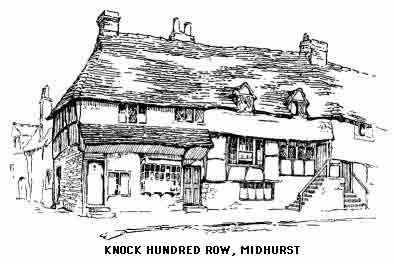
Midhurst
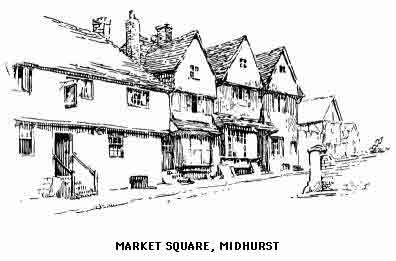
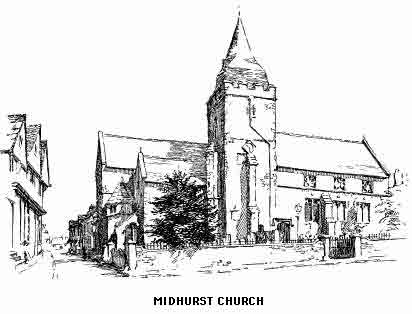
is a pleasant old place with some good ancient houses here and there. Those in the centre which form the subject of Miss Vigers' sketch, are being demolished as this is written; their disappearance will be appreciated by motorists in a hurry but by no one else. The Perpendicular church has been largely rebuilt during the last century and the Montague Chantry lacks its tomb, which has been removed to Easebourne. Richard Cobden was educated in the Grammar School [founded in 1572].
During the last few years Midhurst has become to some extent a resort for Londoners who appreciate a quiet country town amid beautiful surroundings which may be explored easily. The walks, not only to the Downs on the south but northwards to the lovely and remote hills which culminate in Blackdown, are among the best in West Sussex.
South, west, and east the town is well served by the Brighton and South-Western Railways, a single line in each direction.
The road to Henley is one of the loneliest as it is one of the loveliest in south-west Sussex. The writer has tramped the long miles to Henley [uphill all the way] without meeting a single pedestrian. Even the advent of the great Sanatorium on the southern slopes of Bexley Hill does not seem to have made any difference. Possibly visitors use the public motor which runs between Midhurst and Haslemere. By so doing they miss one of the finest woodland walks in the south, indescribably beautiful in the scarlet and gold of late autumn.
The traveller in Downland is advised for once to turn his back on the hills and walk as far as the summit of the Haslemere road where the new route turns sharp round to the left and hugs the escarpment of Bexley Hill. In front will be seen an overgrown track, the old highway, plunging down the face of the hill. A few feet down this causeway, paved with large slabs of stone, brings us to a surprising hamlet clinging to the hillside and, with its "Duke of Cumberland" Inn, looking across the wide Fernhurst vale to where Blackdown lords it on the other side.
At Easebourne, about a mile north-east of Midhurst, is a Benedictine Priory used, until quite lately, as a farmhouse. It is close to the church, which, with the buildings of the nunnery, form three sides of a hollow square. The restoration has been carried out with taste and care and the whole is worth seeing. The nuns of Easebourne would seem to have been "difficult females," for a Bishop of Chichester in 1441 was obliged to call the Prioress to order for wearing sumptuous clothes with fur trimmings and for using too many horses when travelling, the penance being a restriction to four. The nuns were spoken of by a contemporary writer as "wild females of high family put at Easebourne to keep them quiet."
The church, besides the tomb of the first Viscount Montague, removed from Midhurst, contains a figure of Sir David Owen [1540]; also a Transitional font.
next page 3 - Midhurst to Goodwood & Bognor
|