|
St James Church
Mrs Betty Lovejoy (nee Fitz-Simon) is the daughter of the former
Rector and still lives in the village having married Arthur Lovejoy after
his first wife, Bella, died.
She has many vivid memories and says:
When my father came here the parish was almost entirely agricultural
and most people lived in poverty. The only gentry, apart from very
modest ones, were Mr and Mrs Fisher Unwin and Mr and Mrs
Macdonald. The latter lived in Brown's Copse; he had been a Privy
Councillor and she was a cousin to Philip Noel-Baker, later a Nobel Peace
Prize winner, who stayed frequently with them and is buried in our
churchyard.
Of the richer folk very few were actively church people, so
the church shared the general poverty of the village. The church building
itself was rather dark inside and was lit by oil lamps which gave a
brownish light.
The east window was partially obscured by a plaster
reredos (now removed), on either side were rectangular metal plaques
bearing the Lord's Prayer, the Creed and the Ten Commandments.
The
east end of the north aisle was a mess, the space between the front pew
and the window being filled with brooms, spare hassocks and other
paraphernalia.
In the 1920s Mrs Smallwood of North End had this
renovated, and a side altar installed, in memory of her husband.
At the
west end of the church, near the font, was a huge tortoise stove, the
only means of heating. At Evensong in the winter the entire congregation
would be bunched around this stove, leaving a vast space between
themselves and the Rector and choir.
The normal Sunday services were
8.00 Holy Communion, 11.00 Matins and 6.30 Evensong, Once a quarer
there was a 12.00 service of Holy Communion.
Towards the end of this
regime a visiting parson failed to make a pause between Matins and the
following service, and afterwards expressed to Leslie Parry, then Verger,
his admiration at the number of communicants. 'You wouldn't have
had half as many 'said Leslie ' if you had given them a chance to get out!'
The services were usually supported by a choir of six to eight men and
the same number of boys, but on high festivals there were too many to
fit into the stalls or indeed to robe in the vestry. They would process
through the door singing the first hymn loudly.
The choir had some
knowledge of singing because one of the schoolmasters has considerable
skill in teaching it.
He was also a talented cricketer and coach and for
some decades Heyshott had fielded a very respectable team.
There was
also a girls choir, but its members were not robed and they sat in the
front pews of the south aisle. They and the boys came to choir practice
on Thursday evenings and were paid a penny or tuppence for doing
so; There was a further payment for attendance on Sunday.
The organist
in 1923 was Miss Edith Hutt; she was succeeded not long afterwards by
Miss Edith Wright, who continued until her final illness in 1956.
The school was a church school and the two were in close liaison.
Sunday School was taken by the weekday teachers:
Mrs Davis in the
top class, Miss Standing in the second and a succession of younger staff
in the infants.
The Rector was a regular visitor, as indeed he was during
the week.
On Good Friday, Ascension Day and Empire Day the whole
school would be marched down to the church for a 10am service and then
given the day off.
Page 97
Page 98
A big proportion of Heyshott men had fought in the World War 1 and,
on Whit Monday every year, the ex-servicemen held their annual
reunion and dinner. They met at the school, marched in procession to
the church for a service and marched back to the school for a hot dinner
provided by the Mothers' Union. This was still a potent force in the
village and remained so till the appearance of the W.I. in 1931. There
was also a junior branch of the Mothers' Union, the Girls Friendly
Society, who's members were enrolled in the church and enjoined to
follow a rule of purity in thought, word and deed. Somehow it was
never wildly successful!
Occasionally, in a fine summer, the pattern would be varied with a
drumhead service instead of Evensong. I can remember one held on
the Post Office Green in the 1920s, and a marvellously attended one
behind Cobden Club in 1932. There was at the time a Church Army
Mission to the village - its members encamped in caravans near the
Foundry and one, or possible two, Guide Camps elsewhere.
They
together with the choir, the Heyshott Brownies, the school and a large
numbers of villagers made up a huge circle in the meadow.
The last of
these services was run by the Rev Freddie Palmer in 1957.
The war memorial window in the south wall of the nave was
dedicated in 1921 and records the names of the 14 young men who
died. The names of the 9 who died in the Second World War were
added later.
Many of the memorial tablets in the church and headstones in
the churchyard have interesting inscriptions. They are all recorded in
a file hanging at the back of the church.
The churchyard used to end
just north of the present path to the vestry. It was extended twice, first
in 1898 and then again shortly before 1939-45 War.
The earliest headstone which can be read is over 300 years old and
stands under the yew tree in the south-west corner of the churchyard.
It commemorates Katherine Austen who died in 1693. She was a
member of the Austen family which were prominent in the village for
many years and after whom the village council houses are named. It is
a great tribute to the stone mason that the wording is still so clear after
so many years.
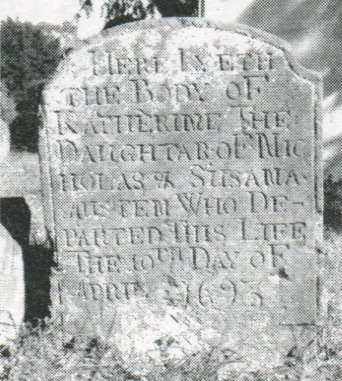 |
HERE LYETH THE BODY
OF KATHERINE THE
DAUGHTER OF NICHOLAS &
SUSANA AUSTEN WHO
DEPARTED THIS LIFE THE
10TH DAY OF APRIL 1693
click to enlarge photograph
|
Page 98
|