|
St James Church
There are three bells. The oldest has no name on it, just two shields
(one with a chevron between three lavers (water jugs) and the other a
chevron between three trefoils) also two Ninfield crosses. the latter
are generally recognised hall mark of the man thought to have
cast the bell, William Founder, who was working at the end of the 14th
century.
The second bell is inscribed 'Prais god' and the initals AW,
MW , RA and WP. The initals AW are accepted to mean that the bell
was cast by Anthony Wakefield in about 1600.
The third bell is inscribed
'William Eldridge made me 1671'.
Several of the older residents can
remember William Parry tolling all three bells with one rope in each
hand and the third round his foot. After his death this same method
was used by Godfrey Kewell who died in 1997.
The bell frame is not in
good enough condition for the bells to be rung up but the two smaller
ones can be tolled.
Apart from the font, all the fittings have been made during the last
100 years. The altar rails, chancel rails and pulpit were made by William
Parry who was for 48 years Sexton and Clerk of the church and was
also the village undertaker, blacksmith, carpenter and builder. A
memorial to him and his wife, Anne, is on the west wall of the nave.
Other interesting memorials on the walls are to Richard Cobden and
to the Rev Caleb Collins.
In the floor of the north aisle is a very worn stone near the altar
inscribed in memory of a child of 2 who died in 1819 and which reads:
My parents dear grieve not for me
I am not left, death sets me free
To rest in joy with angels bright
And sing their praises day and night.
The nave aisle is paved with large tombstones which were probably
moved and do not cover the graves to which they oiriginally belonged.
They record the names of farming families - Cocquerell, Mellersh and Gadd.
Above the door into the church is a painting of the Royal Arms. These
are those of George I and were in use from 1714 to 1800.
From 1882 to the beginning of 1897 Thomas Hooper was Rector and on the wall by the vestry door is a notice which says:
Beneath the vestry floor lie the grave and headstone of a former Rector
of this parish.
Sacred to the memory of the Revd. Thomas Hooper.
Died January 11th, 1987 aged 92 years.
Search the Scriptures for in ME ye have etermal life.
An enquiry carried out by the Sunday Companion in
c1896 showed that Mr Hooper was then the oldest living clergyman in
the Church of England and, at 91, was maintaining a full and active
ministry. A descendant of Bishop Hooper, who was martyred at
Gloucester in the reign of Queen Mary, he was born in Yatton Keynell,
Wiltshire in 1805, and educated at Eton, where Gladstone was at one
time his fag. He was present at the jubilee celebrations & the funeral of
George III, and remembered the comet of 1811 and the superstious excitement it aroused.
Page 95
Page 96
On coming to Heyshott in 1882 he found there
was no Rectory, and arranged for the present one to be built.
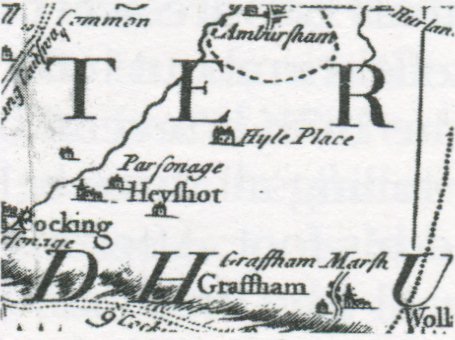
Budgen's map of Sussex in 1724 shows a parsonage house to the
north of the church, one of the four buildings in the parish, apart
from the church, considered large enough to warrant being recorded.
It had clearly gone by the time the Rev Hooper arrived in Heyshott
in 1882. In living memory there were also the remains of the small
tithe barn between Newell's Cottage and the gate to the Glebe field.
In 1915 the Carnegie United Kingdon Trust in Dunfirmline promised
the church a grant of £100 towards the estimated cost of £200 for an
organ. It was paid in 1918 and a 'positive' organ was bought. It was
called a positive organ because, to transpose up or down, all the organist
had to do was to move the console to the right or left. It was a good
little pipe organ which could be pumped either by pedals like a
harmonium or by a boy pumping a handle on the side.
Denys
Hutchens remembers doing this in the 1930s and being paid 1d for
each service.
The organ was removed in the late 1970s when Derek
Gaye gave the existing two manual organ, with a pedal board, in
memory of his mother, Kathleen.
It came from Derek's prep-school,
Windlesham house in Broadstairs, which had closed. It was built in
1931 from money contributed by the school's pupils, staff and parents
who are listed on a plaque on the side of the instrument.
What
happened to the old organ we do not know, but it must have had a rarity
value in addition to the value of the lead pipes.
The Rev E W Fitz-Simon was Rector from 1923 to 1950 and was one
of the longest serving rectors.
He was a lovable old man who, during
the later years of his life, suffered from painful arthritis. when he
christened the Clayton's elder son, now over 50, the god parents stood
very close to him, afraid he might drop the baby in the font!
In 1910 a survey was made of the church plate in all the Sussex
churches. A summary of the Heyshott data is:
A chalice of silver hallmarked 1855
A paten of silver ditto
A flagon of silver ditto
A plated Paten and a Pewter Alms plate.19
The chalice, paten and alms plate are housed in a wooden box which
is inscribed ' Presented to the Parish of Heyshott at the
restoration of
the church on Easter Sunday 1856 by the Hon Mrs Vernon Harcourt'.
Since the 1995 burglarly of the vestry, they are held in a safe place.
Page 96
|