|
Heyshott in Two World Wars
Heyshott seems to have been more than usually successful in making them feel at home and, unlike in other parts of
the country, they chose to stay here until virtually all risk to their homes had gone. Most of the village households took in at least one of them.
The Murrays at Upper Cranmore found in the chest of drawers in their evacuees' bedroom several drawers full of apples and lumps of chalk. Apparently the intention was to take all this back to London when they went home. Another evacuee, when given his dinner by the Poultons at Laurel Cottage, took his plate and sat to eat his meal on the doorstep. This was, apparently, his usual practice at home in Southwark.
It is believed that there was only one major air-raid shelter built in the village and that was for the schoolchildren.
This story of its provision appeared in the local paper in 1940:
This might well be called the story of the village that 'Went to It'! It is
the story of a village that felt very keenly the need for the protection of its
children against air raids and set about providing it off its own bat.
No steps had been taken by any authorities in this rural area to provide air
raid shelters and the people of Heyshott, having nearly 90 children in
the place - locals and evacuees combined - decided that the position of
these children might well be considered dangerous; so it was decided
to do something about it. But the question was, how?
A penny rate in the village would bring in about £8, which would
obviously be inadequate. A three-penny rate, 'tis true, would bring in
about £22, but the Parish Council had no power to levy such a rate and,
in any case, many people in the parish are not too well 'breeched' financially.
To grapple with the problem the Chairman of the Parish Council, Mr S
Knight, called a public meeting. It was then that things started to 'hum'.
A sub-commitee was formed, plans were drawn up, a small army of
volunteers was immediatly forthcoming and, a site having been
procurred on farmer Arthur Lovejoy's farm, digging was commenced
- all within 20 hours!
All labour was voluntary. The men of the village would come home in
the evenings, after a long day in the fields maybe, and set about what
was for them, a labour of love. A large amount of materials for the work
was given by local farmers and residents. Air raid shelters for the children
were needed, and air raid shelters they were going to have - come what may!
With such a zest did these men of Heyshott work that, in the evenings of
only a month, they built two air raid shelters which must surely be the
ne-plus ultra of any air raid shelters in any village anywhere in England.
Indeed so palatial are they that they should, without further delay, be
named the Ritz and the Savoy.
The two shelters, which had benches along the sides, are shown [below], with the school in the background:
Page 168
Page 169
Heyshott in Two World Wars
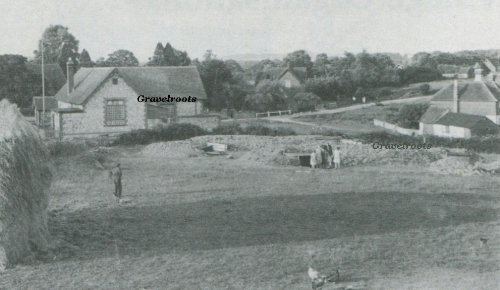
School air raid shelters, Heyshott 1940 - enlarge
Food rationing was quite severe but, like most country villages where
there were farms and allotments, and most houses had gardens, the
effect was much less than in the cities. The WI got extra rations of sugar
to make jam and careful records were kept to justify the extra rations.
Miss Cochrane, who lived at Cranmore House, made the largest
quantity - 101 lbs from 40 lbs of sugar and Miss Pim made 90 lbs. But
the average output was from 6 to 24 lbs.
Although the meat ration was very small, Merrits, the butchers in
Midhurst, continued to deliver to all their customers in Heyshott and
Mr Knight who kept the village shop delivered the groceries.
All in all, although the war had at times been a frightening experience
for many in the village, Heyshott survived very well. Although the
death of its nine young servicemen had hit the inhabitants hard, they were grateful that the casualties had been fewer than in the 1914 - 1918 War.
see Memorial Window, Heyshott Church
Page 169
|