|
The Public Houses
There are records of there having been four inns or public houses in
Heyshott:
The White Horse, the Black Horse, the Lion and the Unicorn.
Only the Unicorn exists today. It is possible that there was also a
public house at Hoyle at one time but no written evidence of this has
been found. Local tradition has it that there was one either in Old Hoyle,
where a trap for lowering barrels into the cellar is said to have been by
the front door or, opposite, at Old Hoyle Cottages, where Mrs Helen
Downes, the present owner, can show the shelves on which the rows
of glasses were kept.
The White Horse is the first for which any record exists. It was located
in what is now Glebe Cottage and Newells Cottage, but these two were
then one cottage owned by Charles Hopkins. The account book for
the Overseers of the Poor of Heyshott shows that, in 1833, one Thomas
Mills paid £1 towards the Poor rate on account of The White Horse
Public House. Then in 1836 Charles Hopkins was granted a licence by
Midhurst Petty Sessions for the White Horse. This was renewed the
following year but it was revoked in 1838. This may not have been for
any misdemeanour but just because Charles Hopkins gave up running
the property as a pub.
The Lion Inn was located in the house now called Heyshott
Farmhouse. It did not operate for very long, as it only started sometime
after 1857, when Henry Pope bought the premises, and ceased by 1880
when it was converted to a Working Men's Club and Coffee House
with the objective of providing a place of recreation, other than the pub,
for the young men of Heyshott. There are only two pieces of evidence
which have been found about the Lion Inn. The first is in a statutary
declaration by Edward Pope of Heyshott, grocer,in 1882 to the effect
that he was the son of Henry Pope, innkeeper, deceased. The second
is that the owner of Heyshott Farmhouse still has an inn sign of a lion
with a white mane on which is inscribed 'Henry Pope licenced to sell
retail beer. Not to be consumed on the premises'.
Very little is known about The Black Horse Inn. the only evidence
which has been found about it is in a deed dated 1916 in which Thomas
Fisher Unwin of Oatscroft conveyed the present Black Horse Cottages
to the trustees of the Cobden Club. In this deed the property is
described as ' three messuages (formerly consisting of one messuage
called or known by the name, and bearing the sign of, the Black Horse)'.
The original licence for the Unicorn was granted to Henry Smith on
5th September 1839. He continued to hold the licence intil 1853 when
it was transferred to George Pink, a master cordwainer, who had been
born at Stedham. The licence remained with the Pink family. first father,
then son, then son's widow, until November 1884 when Henrietta Pink
relinquished it to Henry Rogers, who held it for five years. In 1868 the
property was surveyed by Wyatt and Sons, a firm of Chichester estate
agents, who reported it to be 'occupied by Geo Pink. Front parlour and
tap room, cellar and back kitchen, five bedrooms, detached wash house,
shed and garden'. From 1872 to 1889 the owner of the pub was Charles
Atkey Esquire of Chichester but, in the latter year, it was bought by
Messrs Lambert & Norris, Eagle Brewery, of Arundel and the landlord
changed to Benjamin Dabbs. He remailed the landlord for seven years
until he handed over to Gerard Rassell, who died the following year
and his widow carried on until 1902. In that year the licence was
transferred to Percy Remnant who continued until the end of the Great
War when James Richardson took over.
It is interesting that, although it had five bedrooms in 1868, the licence,
up to 1910, was for an 'ale house', a familiar term in old books for a
place which sold beer but which, unlike an 'inn', was not licenced to
provide accommodation. From 1911 licences were for 'spirit retailers'
who could sell drinks for consumption both on and off the premises.
Page 113
Page 114
James Richardson held the licence for 37 years, much the longest
time in the Unicorn's history. He and his wife were well liked in the
village but they disliked selling food. Douglas Clayton remembers that
' the most one ever got was a 'ploughman's' and that was restricted to
bread, cheddar cheese and either pickles or pickled onions'. Ethel
Richardson, the daughter, had a pre-war Rover car with which she
provided a very comfortable and efficient taxi service.
After James Richardson died on 1955, his widow, Ada, carried on for
a couple of years and then sold up.
During the Ricardson's time there were three bars. entering from
the road (there was no porch then), one came straight into the small
Private Bar which had a wooden partition along its left side in which
there was a door into the Public Bar. Between the Private Bar and the
Farmers and Ladies Bar, which was entered from the present car park,
was another wooden partition with a door in it. There were then no
inside lavatories, no lobby into the Farmers & Ladies Bar and part of
what is now the dining room was the landlord's private living room.
Ada Richardson was succeeded by Arthur Chadwick in 1957. Arthur
Chadwick's wife, Audrey, came from Cairns in Queensland, Australia,
and was an excellent cook. She was the first to introduce nibbles in the
bar at lunchtime on Sundays, in the form of home made cheese straws.
'Mrs Chad's Pie' is also still fondly remembered.
In 1960 the licence was transferred to Sidney Tappenden, a retired
Police Superintendant and then, in 1963, to David Douglas who held it
for 16 years. During his time he bought the freehold from Friary and
the pub became a free house, which it still is. David and Zona Douglas
were a larger than life couple. He was also Secretary of the Cricket
Club, provided the bar at Dunford House was an active member
of the Licence Victualers Association. It was he who removed the
partition between the Private and the Public Bars and called it the Village
Bar. He also discovered and opened up the large open fireplace in the
present bar. Zona was a good cook and became famous for her Chicken
Maryland and Duck a l'Orange. She also took a major part in village
activities such as the Cobden Club, the WI and the Old Friends Club
for pensioners.
In 1979 the pub was bought by Norman Horton, whose wife Barbara
was the daughter of Mr and Mrs Shepherd of Hoyle Lane. They lived at
Trimmers and he was more interested in his building business than in
being a landlord and he left his brother Barry to run the pub, assisted by
Barbara, son Mark and one of Barbara's younger sisters, Margie, who
was an exceptionally cheerful efficient character. Norman Horton
built on the side and back extensions to provide indoor lavatories,an
enlarged restaurant and kitchen, plus still room and storage space.
there were two unforseen results of this. A minor one, except to the
Children, was that the back door to the bar no longer led straight outside
and they could no longer peer in and buy crisps and soft drinks. The
other was that the temperature in the bar rose too much to enable beer
to be kept in, and served straight from, oak barrels supported on trestles at the back of the bar, a good, old-fashioned custom which had probably survived since the 1830s.
Page 114
Page 115
The Hortons did not hold the licence for long and were followed by
a number of others for short periods. Then, in 1993, after planning
permission had been granted for the property to be converted to a
private house, Maria Simpson, who was only 18 and had recently
inherited a fortune, bought the Unicorn, much to the relief of the whole
village. She entered into the spirit of running a pub with great
enthusiasm although,being under 21,the licence had to be held by
her mother, Linda. She carried out major refurbishments and resurfaced
the car park, while her mother decorated the outside with magnificent
display of hanging baskets of flowers. Her fiance Simon Hudson,
was the chef and business rapidly improved, However after four years
very hard work, Maria wanted a change and let the Unicorn to Annie
Boher and her partner Mark Whittaker. They have turned the village
pub into a thriving restaurant with a very high standard of cooking
which attracts people from many miles around.
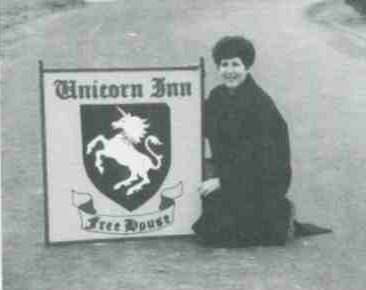
Lisa Roberts with the inn sign she designed
|